
Online Scam Report | Banking Fraud Awareness
Introduction: Be Careful Where You Enter Your Banking Information
Online banking has made managing money easier, but it has also created opportunities for criminals to impersonate financial institutions and create websites that appear to offer legitimate banking services.
One website that deserves particular caution is:
https://acc.silverstoneb.info/
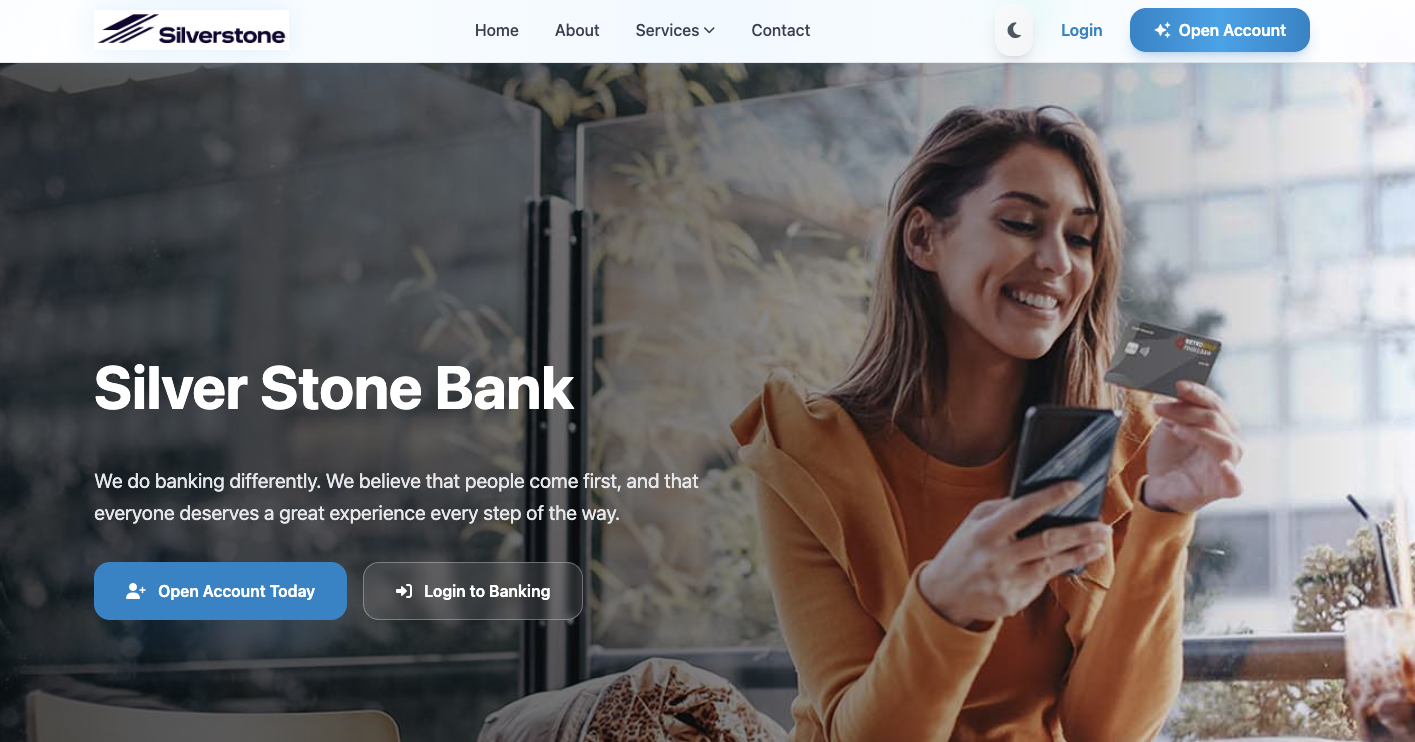
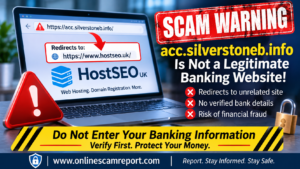
The website is presented through a domain that appears to suggest an online banking account portal. However, an examination of the supplied link revealed a concerning development: instead of displaying a banking platform, the address redirected to HostSEO UK, a website advertising web hosting, domain registration, and server management services.
This raises important questions about the purpose, ownership, and legitimacy of the original web address.
Consumers should not assume that a website is a legitimate bank simply because it has an account login page, displays financial information, or is shared by someone claiming to represent a financial institution.
At Online Scam Report, we encourage consumers to verify financial websites independently before submitting personal information, connecting accounts, or transferring money.
1. What Is acc.silverstoneb.info?
The address supplied for examination is:
https://acc.silverstoneb.info/
The domain uses the name “silverstoneb” and the subdomain “acc,” which could give visitors the impression that they are accessing a bank’s customer account portal.
However, the appearance of a banking-related name in a web address does not establish that the website belongs to an authorized financial institution.
When the address was accessed during our review, it redirected to:
The destination website identifies itself as HostSEO UK and advertises services including:
- Business and cloud web hosting.
- Reseller hosting.
- Dedicated and virtual private servers.
- Domain registration.
- Business email hosting.
- Server management services.
These are hosting and technology services, not ordinary consumer banking services.
The difference between the original banking-style address and the destination website is a significant concern that visitors should not ignore.
Importantly, this observation does not independently establish who owns or controls the original domain. The redirect could have several explanations, and further technical investigation would be needed to establish its cause.
Nevertheless, consumers should not use the original address for banking until its legitimacy has been independently confirmed.
2. Major Red Flags Consumers Should Consider
Several warning signs make it important to exercise caution before interacting with this website.
Red Flag 1: The Website Redirects to an Unrelated Business
The most immediate concern is the observed redirect.
A visitor expecting to access a bank account is instead directed to a website advertising hosting and domain services.
A legitimate bank’s customer login portal should be accessible through a verified official banking domain or an authorized service provider.
An unexplained redirect to an unrelated commercial website creates uncertainty about the website’s purpose and reliability.
Consumers should avoid entering sensitive information into a website whose identity cannot be established.
Red Flag 2: The Banking Identity Has Not Been Independently Verified
A professional-looking web address does not prove that a financial institution exists.
Before trusting a bank, consumers should establish:
- Its complete legal name.
- Its country of incorporation.
- Its registered business address.
- Its banking licence or authorization.
- Its financial regulator.
- Its official website and verified contact information.
If the institution claims to operate in the United States, consumers can check whether it is an FDIC-insured bank through the FDIC BankFind directory.
If it claims to operate elsewhere, consumers should consult the appropriate financial regulator in that jurisdiction.
A business registration or domain registration is not a substitute for banking authorization.
Red Flag 3: An Account Login Page Does Not Prove That a Bank Account Exists
Fraudulent financial websites can display convincing account dashboards, balances, transaction histories, and withdrawal interfaces.
These displays may create the impression that money is being held in a genuine bank account.
However, a number displayed on a website is not proof that the corresponding funds exist in a regulated financial institution.
Consumers should independently confirm account ownership and available balances through a verified bank, rather than relying on screenshots or information provided by an unknown website operator.
Red Flag 4: The Possibility of Personal and Financial Information Exposure
An unverified banking website may expose visitors to risks involving personal and financial information.
Information that criminals may attempt to obtain includes:
- Full names and residential addresses.
- Banking usernames and passwords.
- Account and card numbers.
- Identification documents.
- Security codes and verification information.
- Personal identification numbers.
If a website cannot be independently verified, visitors should not submit this information.
Red Flag 5: Potential Withdrawal or Account Release Charges
Consumers should be particularly cautious if someone directs them to this website and claims that money is waiting in an account.
Warning signs include requests to pay:
- Account activation fees.
- Withdrawal clearance charges.
- Account verification fees.
- International transfer fees to release funds.
- Anti-money-laundering certificates or processing charges.
- Taxes or security deposits demanded before a withdrawal.
Some financial institutions legitimately charge disclosed fees for certain services. However, an unexpected demand for payment to unlock supposedly available funds should be independently verified with the institution through an official contact channel.
Never pay an unfamiliar person or organization simply because they claim that a withdrawal cannot proceed without an additional payment.
3. How Fake Banking Websites Can Be Used in Financial Scams
Fake banking websites can be used in several types of fraud.
Fake Employment and Payment Scams
A victim may be told that they have earned money through a job, freelance assignment, online task, or business arrangement.
They are then instructed to open an account through an unfamiliar banking website to receive their payment.
The website may display an alleged balance, but the victim is subsequently told to pay a fee before withdrawing the money.
Investment and Cryptocurrency Scams
A person may be shown an online investment balance and told that their profits have been transferred to a bank account.
They may then receive a link to an unfamiliar banking portal and be encouraged to log in to claim the funds.
The displayed balance may be fabricated, and additional payments may be demanded.
Romance and Impersonation Scams
Fraudsters may use personal relationships or false professional identities to persuade victims to trust an unfamiliar financial website.
They may claim to be transferring money, sending an inheritance, releasing an investment, or arranging an international payment.
Victims should never assume that a financial website is legitimate simply because someone they trust has recommended it.
4. What Should You Do If Someone Sent You This Website?
If someone has shared acc.silverstoneb.info with you and instructed you to open an account, receive money, or make a payment, consider the following precautions.
1. Do not create an account yet.
Wait until the institution and its banking authorization have been independently verified.
2. Do not enter your personal information.
Avoid submitting identification documents, passwords, bank details, or security codes.
3. Do not transfer money.
Do not pay supposed activation, withdrawal, clearance, or account verification fees without independently confirming their legitimacy.
4. Verify the financial institution.
Identify the institution’s complete legal name and check its authorization with the relevant banking regulator.
5. Contact your actual bank.
If someone claims to have transferred money to you, contact your existing bank through its independently verified telephone number or official application.
6. Preserve the evidence.
Save the website address, messages, emails, screenshots, payment requests, and any instructions you received.
These records may be useful if you need to report suspected fraud.
5. What If You Have Already Used the Website?
If you have already visited the website, do not panic. Your next steps depend on what information or permissions you provided.
If You Only Opened the Link
Close the website and avoid interacting with it further. Visiting a page alone does not necessarily mean your information or device has been compromised.
If You Entered Your Password
If you reused that password elsewhere, change it immediately on the legitimate services involved. Enable multifactor authentication wherever possible.
If You Submitted Banking Details
Contact your actual financial institution immediately. Explain what happened and ask whether your account, card, or online banking access needs to be secured.
If You Uploaded Identification Documents
Contact the relevant identity document issuer or identity-theft assistance service and ask about protective steps.
If You Sent Money
Contact your bank, card provider, or payment service immediately. Explain that the payment may have been associated with fraud and ask whether it can be stopped, recalled, disputed, or investigated.
Do not pay additional money to anyone promising to reverse the transaction.
6. How to Verify Whether a Banking Website Is Legitimate
Before using an unfamiliar financial website, consumers should conduct independent checks.
For US banking institutions:
The FDIC BankFind directory allows consumers to search for FDIC-insured banks and branches:
https://banks.data.fdic.gov/bankfind-suite/bankfind
For UK financial institutions:
The Financial Conduct Authority provides a register for checking authorized financial firms:
For Australian financial institutions:
The Australian Securities and Investments Commission provides information about financial services and professional registers:
Consumers should also check whether the website address matches the official domain published by the institution.
A padlock symbol or HTTPS connection only indicates that a connection is encrypted. It does not establish that the business operating the website is legitimate.
7. Our Recommendation: Do Not Trust an Unverified Banking Website
Based on the website behavior observed during our review, we strongly advise consumers not to use acc.silverstoneb.info for banking or submit sensitive financial information through it unless its legitimacy has been independently established.
The unexplained redirect to HostSEO UK, rather than a recognizable banking service, is a significant warning sign.
We could not establish from the available evidence that the domain belongs to a licensed bank or that any financial institution operates the account portal.
Until the website’s ownership, banking authorization, and purpose are independently confirmed, consumers should avoid opening accounts, submitting documents, entering passwords, or transferring funds through it.
If someone has presented this website as the destination for a payment, withdrawal, investment return, or recovered funds, verify the claim directly with the relevant financial institution before proceeding.
Conclusion: Protect Your Money Before It Is Too Late
Financial fraud does not always begin with an obvious warning. Sometimes it starts with a convincing message, a professional-looking account portal, or a promise that money is waiting to be collected.
That is why independent verification matters.
The website acc.silverstoneb.info raises serious questions because the address redirected to an unrelated hosting-services website during our review. This behavior should not be ignored, particularly when the website is being presented as a banking portal.
Consumers should remain cautious, preserve evidence, verify financial institutions through official registers, and report suspected fraud promptly.
At Online Scam Report, our goal is to help individuals recognize suspicious online activity, understand reporting options, and make informed decisions when dealing with suspected financial fraud.
Do not let an unfamiliar website put your money or personal information at risk. Verify first. Protect yourself. Report suspicious activity.
Visit www.onlinescamreport.com for online scam awareness and reporting information.